
'It is a calling': Photojournalist Lynsey Addario on capturing the human toll of war

Lynsey Addario on assignment in Iridimi Refugee Camp in Wadi Fira, Chad, in a scene from the documentary Love+War that premiered at the Toronto International Film Festival (TIFF) this year.
The boom of artillery still echoes in Lynsey Addario's memory.
Days after Russia's full-scale invasion of Ukraine began in 2022, she stood just metres from a mortar strike near Irpin, her camera clicking through the chaos. Gravel sprayed her neck as families ran for their lives.
"My instinct was to flee. But I told myself, no, I've just witnessed the intentional targeting of a family, and I need to stay and photograph this," she told Matt Galloway on The Current.
The images she captured that day — of civilians killed while trying to escape — would land on the front page of the New York Times and be seen around the world.
For more than two decades, Addario has built a career on documenting conflict and its human toll, often focusing on women and children, in some of the world's most volatile places.

Addario photographs a damaged building in Ukraine.
Now, her own story is in focus. Love + War, a new documentary that premiered at the Toronto International Film Festival, follows Addario through Ukraine while also tracing her path from a middle-class upbringing in Connecticut to becoming one of the most recognized photojournalists of her generation.
Here's part of her conversation with Galloway, including why she believes bearing witness — especially as a woman and a mother — is both her calling and her responsibility.
When you're making a photograph, what are you looking for?
I'm looking for emotion. I'm looking for a connection. Mothers can often relate to mothers. Fathers can relate to a father with an injured child. And so I'm always trying to connect us no matter how far I am from where my readers are.
This is a film that is about the things that you've seen, but it's also how you end up in this position. You come from this middle-class family. Your parents are hairdressers. You end up with a camera and you end up doing this work, but there are a bunch of things that you have to get through to get to where you are.
You tell a story about meeting with somebody at the New York Times, the foreign picture editor at the New York Times, who's sitting there. And the way that you describe it is with his legs spread, sipping his whisky.
I mean that was actually deep into our working relationship. You know, I started working with him several years prior, and what I realized was that once I became a mother, this editor decided to sort of stop sending me to war.
We were at his house having dinner. And there I said I want to go to Mosul [in Iraq]. I want to be covering Mosul. And he just looked at me, and at first, he said, I'm not sending you to war. You're a mother now.
And then I said, OK, if you're not going to send me, send another woman. Like we need women covering war. And he said, there are no women good enough to be working for the New York Times.
And to me, that was a really definitive moment because I thought, OK, if you have an issue with me as a woman and a mother, there are other women who don't have children who are extraordinary photographers, and they are working very regularly.

Addario says goodbye to her son Lukas before leaving on assignment.
But I think that there is something ingrained in our heads as a society. Like, people are protective of women. And, you know, maybe editors don't want to send women and don't want to send mothers to the front line because they feel protective and they feel responsible. If something happens to a mother, it's more devastating in someone's head than if something happens to a father. And I find that problematic.
If we don't have women like yourself who are out there documenting what's going on in the world — this is part of the thrust of your work — what don't we see, and what are you able [to see], and what are you focusing on to show the rest of the world that perhaps great war photographers who are men maybe don't see?
Well, I don't know if it's a matter of they don't see. I think we all choose our focus, and we all have interests as photographers and as journalists.
But these are the kind of pictures that we don't see if it's just men who are out there in some ways.
It's hard for me to say because I think there are some men who are doing incredibly sensitive, intimate work. It's not a lot of them, because war is riveting in so many other ways photographically. You know, there's the flash, there's the drama, there's emotion and it's tense. And I think men are drawn to the front line. They're drawn to combat.
But for me personally, when I look at … the first year in the war in Ukraine, I was covering the front line a lot, and I was off and working in Donbas and all over Ukraine, really, with the troops.
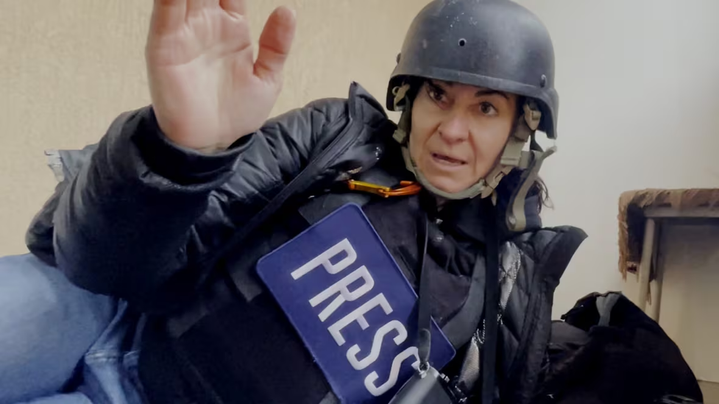
Addario finds shelter from a nearby shelling during an assignment in Ukraine.
But at some point, I thought, what am I contributing to the narrative of this story? And so for me, it's all about, how can I move this story forward? And so I don't know if it's a gender thing as much as we have our interests as human beings.
And maybe at this stage in my life, I'm 51, I'm more interested in showing the human toll: the toll on mothers, the toll on women and children. And so maybe it's just me personally. I can't say definitively it's gender.
Dexter Filkins, who was a colleague of yours at the New York Times, he's now at The New Yorker, says you are really good. The proof is your pictures and that you are still alive. There are stories in this film about how close you were to not making it out of situations.
I feel it's almost like a religion for me. I mean, it is a calling. It is something that I believe so wholeheartedly in doing. And I love people. I love telling their stories. I find it an absolute privilege, and I think we need perspective as human beings.
We're in a world now with AI and social media and all of these things that sort of try and connect us through computers or try to give us information. But actually, there is no substitute to human relations, and there is no substitute for being a photographer or journalist who goes and sits and has a cup of tea with someone on the other side of the world and just listens to them.
That is invaluable in a world where we need to understand each other better, we need to understand our differences.